
Corrections to the Hamiltonian induced by finite-strength coupling to the environment
Łobejko, Marcin and Winczewski, Marek and Suárez, Gerardo and Alicki, Robert and Horodecki, Michał
Phys. Rev. E2024
Research
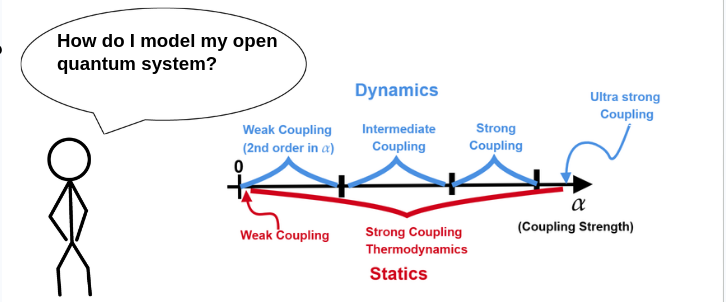
Open quantum systems exchange energy, information, and entropy with their surroundings. My research asks when the standard Markovian and weak-coupling descriptions remain valid, and what replaces them when the environment has structure and memory. I am particularly interested in the thermodynamic consequences: how work, heat, and entropy production are defined away from the weak-coupling limit.
A recurring question across these themes is how to build reduced models that are accurate and practical without enlarging the Hilbert space with auxiliary modes.
Exact open-system dynamics is rarely available beyond extremely simple models. Master equations provide a practical descripton, but their validity depends on the coupling strenght regime and on the time scale of interest. I work on exploring where different methods work, and development of methods, particularly the ExpZ/refined weak coupling limit/cumulant equation, and approximate-environment constructions that keep the numerical cost manageable while preserving the correct steady state and transient behavior. These methods are usually benchmarked using numerically exact solutions such as the hierarchical equations of motion or pseudomodes.
Relevant papersPhys. Rev. E 113, 064121 (2026)Phys. Rev. E 110, 024110 (2024)Phys. Rev. E 110, 014144 (2024)
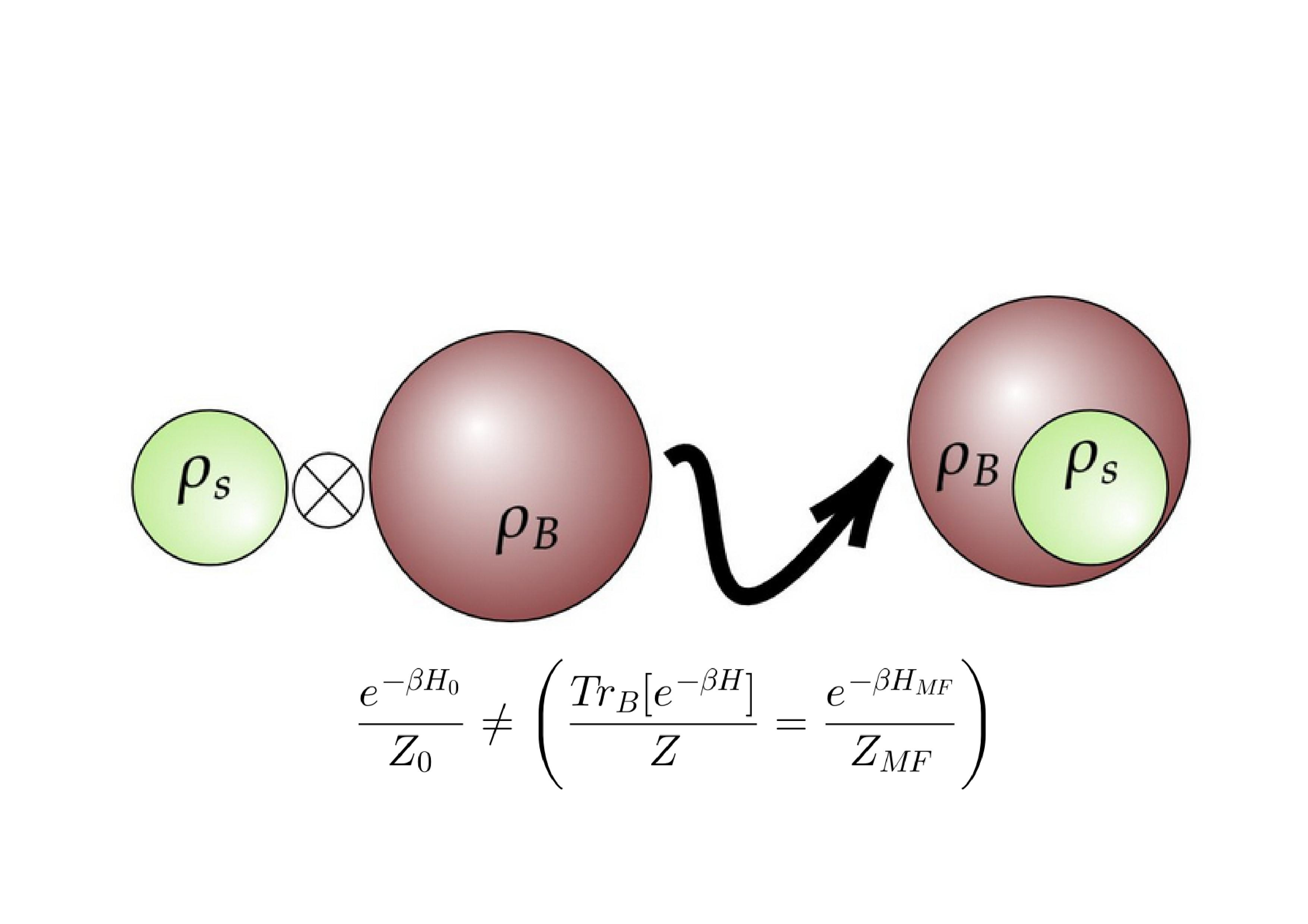
In the standard weak-coupling picture, the steady state is assumed to be a Gibbs state of the bare system Hamiltonian. However, as long as the coupling between the system and bath is finite, the interaction modifies this state ``dressing" the system and leading to noncanonical steady states. I study the consecuences of not relaxing to canonical Gibbs states, as well as the general form of this ``dressed" Hamiltonians
Relevant papersPhys. Rev. E 110, 014144 (2024)
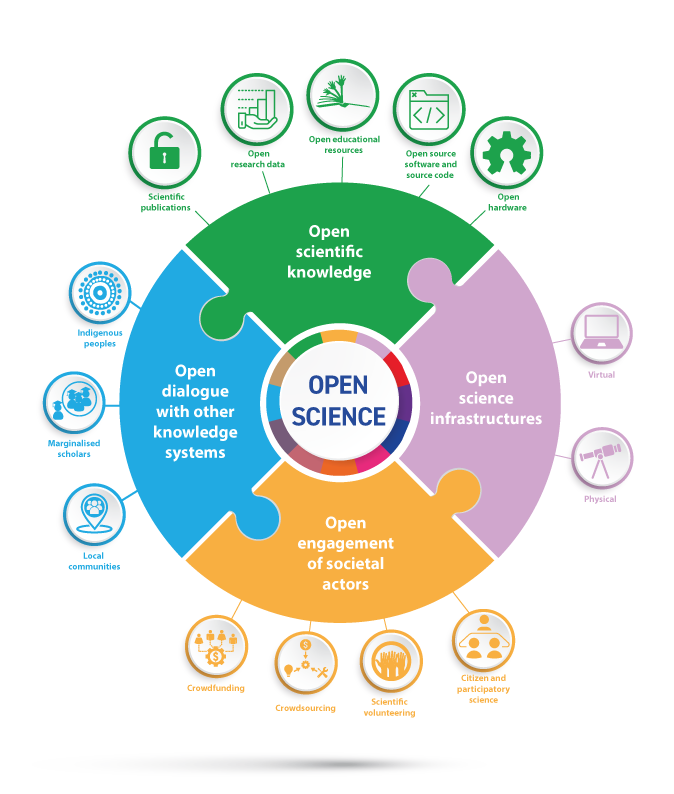
Science is useful only when it can be reproduced and reused. In the past I have contributed to the QuTiP ecosystem and aim to provide the code necessary to reproduce each publication.
Relevant papersPhysics Reports 1153, 1–62 (2026)Phys. Rev. A 110, 042428 (2024)Phys. Rev. E 110, 024110 (2024)
Source: OpenAlex · Retrieved 2026-11-16
567 citations across 5 works, 2022–2026.
| Year | Citations | Cumulative |
|---|---|---|
| 2022 | 6 | 6 |
| 2023 | 12 | 18 |
| 2024 | 35 | 53 |
| 2025 | 144 | 197 |
| 2026 | 370 | 567 |
Node size represents citations. Links connect works that share at least one co-author. Use “Choose papers” to hide works from both plots. Thicker links mean more shared co-authors.
OpenAlex metrics may differ from Google Scholar. OpenAlex coverage can also be smaller, so its counts may be lower than Scholar's.
Łobejko, Marcin and Winczewski, Marek and Suárez, Gerardo and Alicki, Robert and Horodecki, Michał
Phys. Rev. E2024

Suárez, Gerardo and Łobejko, Marcin and Horodecki, Michał
Phys. Rev. A2024

Alicki, Robert and Horodecki, Michał and Jenkins, Alejandro and Łobejko, Marcin and Suárez, Gerardo
New J. Phys.2023
 DOI
 arXiv